This guide explains how trucking companies design and operate trucker payroll with clear pay rules, accurate timekeeping, and compliant recordkeeping. It outlines objective background on common pay components in road freight and the operational risks that cause payroll errors. Readers will also find a comparison table, a step-by-step setup approach, and practical conditions to meet.
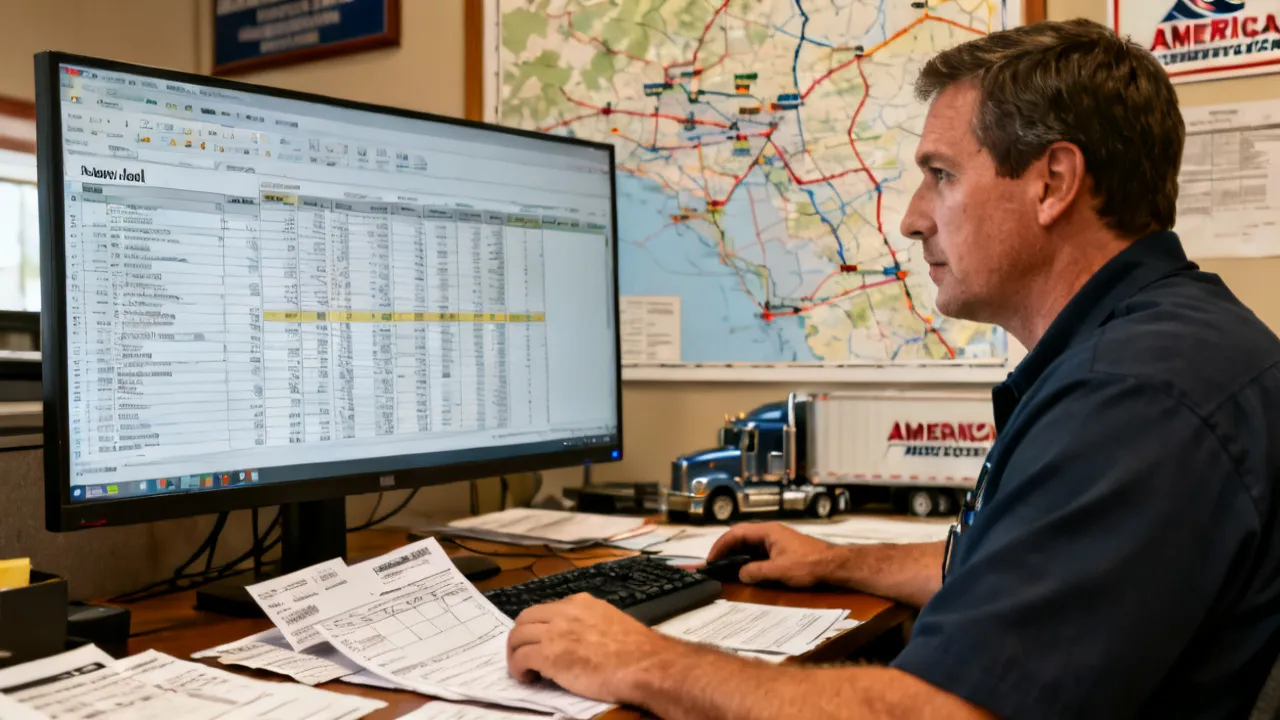
Effective trucker payroll management is not just an accounting task—it directly affects pay confidence, scheduling stability, operational continuity, and compliance outcomes for carriers of all sizes. In trucking, even small payroll inaccuracies can cascade into larger issues: drivers lose trust, morale drops, dispatch and operations become entangled in pay corrections, and HR and finance teams spend time on disputes rather than on improving performance. When pay rules for mileage, hours, reimbursements, incentives, deductions, and adjustments are translated into consistent payroll logic, companies reduce disputes and strengthen operational reliability.
From an industry-expert perspective, the critical success factor is governance: a documented methodology for how each compensation element is calculated, validated, and archived. The second factor is data quality—especially the integrity of time, miles, route proof, and expense documentation. The best payroll systems do not merely “produce numbers.” They preserve the logic and evidence required to explain how those numbers were formed, so that issues can be resolved quickly and transparently.
Moreover, trucker payroll design strongly influences driver retention. Drivers who experience recurring “mystery deductions,” unexplained pay swings, or inconsistent incentives are more likely to search for better-paying opportunities. Conversely, fleets that can show clear pay statements, consistent incentive criteria, and timely processing build a reputation for fairness. In a competitive labor market, that reputation becomes a recruiting asset.
Trucker payroll often combines base wages with variable elements tied to route work, load performance, regulatory-compliant working time, and company-specific compensation plans. While compensation structures differ by company, union agreements (where applicable), and labor rules, complexity usually concentrates in a few areas. These areas tend to interact with each other, which is why payroll design matters so much: a mismatch in one dimension can distort the whole payroll picture.
Common components include:
In practice, payroll problems rarely come from “bad intent.” They tend to come from mismatches between operational reality and payroll logic. Payroll errors usually originate at points where systems translate field events into payroll codes. If those translations are unclear or inconsistent, pay becomes difficult to audit and easy to dispute.
Typical failure points include:
Preventing payroll errors requires more than “doing payroll carefully.” It requires designing a payroll system where each pay element is traceable back to a source event and a documented rule. That means the system must support both calculation accuracy and explainability.
Compliance requirements depend on jurisdiction and employment arrangements, but across many regions carriers face similar themes: accurate time records, lawful deductions, and auditable pay calculations. In the United States, the U.S. Department of Labor provides wage-and-hour guidance and emphasizes accurate recordkeeping and compliance with applicable wage payment rules. For trucking, the Federal Motor Carrier Safety Administration (FMCSA) and related regulatory frameworks shape record practices around driver hours, safety, and documentation related to operational compliance. (For formal regulatory language and updates, consult official sources such as the U.S. Department of Labor and FMCSA.)
Beyond “federal rules,” carriers also face state wage payment laws, local requirements, and contractual conditions. Even when a payroll computation might appear “reasonable” internally, it can be noncompliant if recordkeeping is insufficient or if deductions are processed without required authorization and evidence.
Expert guidance: Instead of treating compliance as a quarterly checklist, implement a “continuous compliance” approach. That means validating data inputs daily, reconciling exceptions weekly, and archiving payroll calculation logic and approvals in a way that can be produced quickly during internal audits or external inquiries. Continuous compliance is also practical: it reduces last-minute scramble, prevents repeated mistakes, and provides a better driver experience because pay is corrected closer to the time the issue occurs.
Consider the difference between detecting an error during payroll run versus discovering it after a driver calls two weeks later. The earlier you detect, the cheaper and less disruptive the correction becomes. The payroll design should assume that errors will occur (because data is imperfect) and should be built to detect them systematically.
Companies often ask about “price,” but payroll cost is not one-size-fits-all. It depends on factors such as driver count, pay model complexity, integration needs (telematics, timekeeping, dispatch, accounting, and expense tools), geographic coverage, and the level of manual adjustment required. Because pricing varies widely by vendor and scope, it’s best to treat it as a procurement exercise rather than an assumption.
Many procurement decisions fail because they only compare monthly software fees. In trucking payroll, the hidden costs usually come from:
How to evaluate cost objectively: request a written quote that itemizes setup fees, per-driver or per-pay-period costs, integration costs, support levels, and any compliance or reporting add-ons. Compare not only monthly price, but total cost of ownership—particularly the cost of corrections, disputes, and staff time. Ask vendors how they handle late submissions, retroactive changes, and audit trails; those answers will often reveal whether the solution truly supports trucker payroll governance or simply performs calculations.
Payroll and HR tooling for trucking typically falls into three broad categories. Each category can work well, but each has different strengths and risks depending on how mature your data processes are and how complex your pay plan is.
Common categories include:
As an industry-expert lens, the key is integration depth and auditability. A tool that “outputs numbers” without preserving the logic behind those numbers can increase risk during disputes or audits. Look for capabilities such as:
Below is a practical approach that reflects how many mature carriers structure payroll controls. The intent is to reduce exceptions and ensure every calculated element can be explained and verified. Treat payroll setup as a system design exercise rather than a one-time software configuration event.
In a healthy payroll ecosystem, the following roles exist and communicate: dispatch/operations, driver management (including onboarding and pay training), payroll administrators, finance, HR/compliance, and leadership. Even when these roles are small-company roles, you still need clear decision authority and clear evidence standards.
| Approach | Top for | Typical Strength | Typical Challenge | Conditions / Requirements |
|---|---|---|---|---|
| In-house rules + payroll software | Mid-sized fleets with stable pay plans | Control over compensation logic and reporting | Rule maintenance can become heavy | Documented pay policy; clear approval workflow; consistent data feeds |
| Integrated transport & payroll suite | Fleets with complex trips and variable pay components | Better reconciliation across miles, time, and trip records | Higher implementation effort | Defined source-of-truth systems; integration testing; exception procedures |
| Managed payroll service | Carriers prioritizing outsourcing and centralized expertise | Specialist processing and structured review | Data turnaround and access constraints | Timely submission of driver records; defined change control for pay rules |
| Hybrid model (software + internal oversight) | Organizations transitioning from spreadsheets | Incremental improvement without full disruption | Temporary duplication of work during transition | Dual-run period with reconciliation; clear sign-off authority |
Below is a practical implementation sequence. It is designed to reduce risk by clarifying pay logic before automating it, and by verifying outputs with controlled tests before allowing full production runs.
Even with modern tooling, stable payroll requires operational discipline. Mature payroll operations treat payroll as a controlled process with defined inputs, transformation logic, and validated outputs. Common conditions include:
When these conditions exist, payroll becomes predictable. Predictability reduces churn and improves driver trust because pay outcomes align with what drivers expect based on operational events.
Driver retention is often discussed in terms of pay rates alone, but payroll design affects retention just as much. Drivers experience payroll through pay stubs, settlement timelines, and how easily they can verify pay accuracy. A fleet that pays competitively but processes payroll inconsistently may still struggle with attrition.
Several retention mechanisms are influenced by payroll:
From a practical standpoint, retention improves when payroll supports driver-facing transparency. That means clear pay statements and a structured method for drivers to see what inputs contributed to their pay. Even when you cannot share every internal rule, you can share the key components: base pay, mileage miles used, incentive eligibility and status, reimbursements, and deductions with descriptions.
To design robust trucker payroll logic, carriers must understand frequent operational scenarios that create variable pay. Modeling these scenarios into structured exceptions can reduce manual adjustments and disputes.
Detention pay is frequently contentious because it blends operational events (arrival times, departure times) with eligibility rules (how long is free, what counts as “productive,” and how discretion is handled). A stable model requires:
Drivers often face route modifications due to construction, customer instructions, or safety constraints. Mileage-based pay becomes complicated when dispatch-estimated miles differ from actual driven miles. A stable approach includes:
Importantly, the mileage source-of-truth decision should consider data reliability. If telematics can fail in certain areas, you may need fallback rules that are still structured and auditable.
Incentives like on-time delivery or load completion require proof. A strong incentive model should include:
When incentive rules are ambiguous or when the system cannot explain how eligibility was determined, disputes become frequent. Traceability reduces disputes.
Reimbursements can be a major source of delays and friction. Carriers should define reimbursement logic and evidence requirements. For example:
A payroll design that treats reimbursements as “optional fields” rather than governed pay elements will lead to inconsistent processing. Governed reimbursement logic reduces the number of rework cycles and increases driver satisfaction.
Deductions can be lawful, but they are sensitive because drivers may perceive them as unjust even when they are authorized. Therefore, deductions require:
Payroll systems that allow “quick deduction edits” without approvals or evidence tend to cause disputes. Payroll governance should make deductions deliberate events, not ad hoc actions.
Governance is the structural discipline that makes payroll accurate, compliant, and auditable. In trucking, governance prevents chaos when operational volatility increases—new routes, new customers, new equipment, and changing driver schedules.
Strong governance typically includes:
Without governance, payroll may still compute correct numbers occasionally, but it becomes difficult to prove correctness. Defensibility matters because disputes and audits require evidence and logical consistency.
In trucking payroll, data quality is not a “nice to have.” It is the difference between accurate pay and recurring disputes. Payroll design depends on reliable inputs. If inputs are noisy, missing, or inconsistent, payroll logic cannot reliably compute outcomes.
Key data quality dimensions include:
Carriers can improve data quality by standardizing event capture, integrating systems more deeply, and implementing validation rules that detect missing or anomalous data before payroll run completion.
One of the most effective approaches to payroll reliability is reconciliation. Reconciliation is the process of comparing expected outcomes (based on source data and pay rules) to the payroll results produced by the system. This step catches issues early and provides a feedback loop to improve processes.
Reconciliation should include:
Validation should not be performed only by payroll administrators. When dispatch and operations understand the validation outcomes, they can correct data capture upstream—reducing the burden on payroll teams and improving driver pay reliability.
Payroll cutoffs are operational agreements between “when data is due” and “when payroll is computed.” If cutoffs are misaligned with how trucking operations work, payroll will repeatedly run with incomplete data, generating chronic corrections.
A well-designed payroll calendar includes:
Late data management should be formalized. If late records are handled informally (“just add it later”), payroll becomes unpredictable and disputed. Formal exception workflows preserve governance while allowing operational flexibility.
When evaluating payroll tooling or services, you should ask questions that directly test governance, traceability, and reconciliation capabilities. Price matters, but governance maturity matters more in trucking.
Consider asking:
Answers that focus only on reporting outputs may be insufficient. You want answers that focus on explainability, audit trails, and structured workflows.
Because payroll rules intersect with wage-and-hour compliance and recordkeeping expectations, carriers should rely on authoritative guidance rather than assumptions. In the United States, the U.S. Department of Labor and the FMCSA provide foundational references for wage payment principles and driver-related regulatory context. For organizational best practices, many carriers also consult guidance from established payroll and HR compliance frameworks and industry associations.
When policies or systems change, carriers should validate updates against current official requirements. This includes verifying whether recordkeeping approaches still meet requirements, whether wage payment rules have updated requirements, and whether any operational compliance guidelines affect how time is recorded.
Additionally, a well-designed payroll governance process should include periodic compliance reviews. Compliance reviews should consider:
It’s important to note that payroll compliance is a specialized field. Carriers should work with qualified professionals for specific interpretations, especially when employment classifications, multi-state work, or deductions are involved.
To manage trucker payroll effectively, prioritize traceability: every computed number should map back to a defined pay rule and a specific source record. When operations, payroll, and any supplier tooling share a common data backbone and a documented logic layer, payroll errors become less frequent and easier to correct.
Traceability also supports driver communication. When a driver asks “Why is my incentive different?” or “Why did my mileage pay change?”, the carrier can respond with clarity, show the supporting records, and resolve issues faster. That speed directly influences trust.
If you’re evaluating suppliers or redesigning processes, treat it as a system: define inputs, encode rules, validate outputs, and preserve audit trails. That approach improves accuracy now and lowers operational friction as your fleet grows or your routes diversify.
Finally, remember that payroll is part of the operational experience for drivers. Good governance, data quality, validation, and structured exceptions create a payroll environment where drivers feel paid fairly and on time—two factors that strongly support retention and long-term fleet stability.
Trucker payroll typically includes base wages plus variable compensation such as mileage or route-based pay, incentives or bonuses, reimbursements for qualifying expenses, and any required deductions. The exact elements depend on the employment model and the carrier’s written pay policy.
The very common drivers of disputes are mismatches between trip/mileage data and the pay calculation method, unclear incentive eligibility, late or missing documentation, and inconsistent handling of exceptions like route changes or delays. Disputes also become more frequent when payroll cannot easily show which source records were used or which rule version applied.
Either can work, but the key is consistency and transparency. Select one methodology as the source of truth for payroll calculations and document how differences are handled when operational records differ. If telematics is used, define what happens when telematics is missing or incomplete.
Reduce manual work by standardizing driver coding, automating reconciliation checks, setting clear cutoff dates, defining structured exception categories, and ensuring operational systems capture payroll-relevant events in a consistent format. Over time, measure exception categories to identify where to improve data capture or adjust pay rules.
Keep payroll ledgers and pay stubs, time records, trip or mileage records, incentive eligibility evidence, reimbursement documentation, authorization records for deductions, and an archive of payroll calculation logic and approvals. Specific retention requirements vary by jurisdiction, so align with applicable local rules and official guidance.
Compliance and accuracy reinforce each other. When time and compensation are calculated using validated source data and documented rules, it becomes easier to demonstrate lawful payment practices and to respond to inquiries or audits. Poor recordkeeping can create compliance risk even if calculations appear “close enough,” so traceability is a compliance advantage.
Pricing commonly depends on driver volume, frequency of payroll runs, integration complexity with operations systems, and the level of managed support. Request itemized quotes and assess total cost of ownership, including implementation and ongoing reconciliation workload. Also ask about costs for exception handling, retroactive corrections, and reporting requests.
Neither approach is universally top. Outsourcing can reduce internal processing burden and leverage specialist expertise, while in-house operations can offer maximum control. The optimal choice depends on your data quality maturity, pay plan complexity, governance capabilities, and your ability to provide timely, complete source data.
A policy should specify pay components, eligibility rules, calculation methodology, data sources, approval workflows, exception handling, dispute resolution, cutoffs, and record retention expectations. Include examples of common scenarios (detention, route change mileage, incentive eligibility, reimbursements, and deductions) so staff and drivers interpret the policy consistently.
There is no single universal timeline that applies everywhere, but carriers should aim to resolve disputes promptly based on the severity and evidence availability. A best practice is to establish a documented dispute workflow with expected response times, evidence requirements, and escalation paths. Timely resolution reduces driver dissatisfaction and prevents recurring disputes.
Note: This guide provides general information and does not constitute legal or tax advice. Payroll compliance requirements vary by jurisdiction and employment arrangements; consult qualified professionals for decisions specific to your operations.
How Progressivecommercial.com Supports Smarter Commercial Buying

Progressivecommercial.com Guide for Buyers and Suppliers

A Practical Guide to Progressivecommercial.com Sourcing

Progressivecommercial.com Sourcing Guide for Buyers

Building Reliable Procurement with Progressivecommercial.com

How Progressivecommercial.com Supports Smart Commercial Buying

How ProgressiveCommercial.com Supports Smarter Business Sourcing

How Progressivecommercial.com Shapes Modern Procurement

How Progressivecommercial.com Supports Smarter Commercial Procurement


Modern Trucker Payroll: Compliance, Costs, and Top Practices
This guide explains how trucker payroll should be structured to support compliance, accurate pay calculations, and predictable operating costs. Background context covers common payroll components in trucking—mileage and hours tracking, overtime rules, deductions, and documentation—then offers a practical framework for building a reliable process using expert-validated controls and audit-ready records.

Trucker Payroll Management for Reliable Compensation
This guide explains how trucker payroll should be structured for accurate pay, compliant records, and predictable budgeting. Trucker payroll refers to the calculation and payment process for drivers and other fleet staff, typically covering base wages, overtime, reimbursements, and legally required deductions. It also addresses timekeeping integrity, contractor distinctions, and audit readiness.

Trucker Payroll: Compliance, Calculation, and Top Practices
This guide explains how to design reliable trucker payroll operations, from pay-rate setup and overtime rules to deductions, benefits, and audit-ready reporting. It provides objective background on common payroll components in trucking, why documentation matters for compliance, and how to reduce disputes while improving cost control. Guidance focuses on practical steps and decision criteria used by fleet managers and payroll specialists.

Trucker Payroll: Compliance, Costs, and Expert Practices
This guide explains how trucker payroll is structured, calculated, and audited to keep drivers paid accurately and compliantly. Background context covers what payroll for trucking typically includes, why payroll systems must match payroll law and trip realities, and how companies reduce errors through disciplined recordkeeping, standardized pay rules, and transparent documentation.

Trucker Payroll: Expert Guide to Fair, Compliant Pay
This guide explains how to structure and manage trucker payroll with accuracy, compliance, and operational clarity. It reviews what “trucker payroll” typically includes, how wage components like hours, rates, and allowances interact, and why consistent documentation matters for audits and retention. Background context is provided objectively, without assumptions.

Trucker Payroll Essentials for Modern Fleet Compliance
This guide explains how to set up and audit trucker payroll with accuracy and regulatory confidence. It reviews what “trucker payroll” typically covers, why pay components require careful recordkeeping, and how fleets can align driver compensation with hours, deductions, and contract terms. Background sections outline key concepts and industry top practices using objective, verifiable sources.